Decreased customer handle time
01OttoMate
Streamlining customer service workflow and supporting human connection with integrated AI-powered workspace

Impact
Decreased escalation volume
Increased specialist confidence
Problem

Customer service specialists operate in a complex, multi-system environment.
Customer service workflows consist of a series of real-time decisions. To make those decisions, specialists at Progressive must navigate fragmented information, frequent interruptions, and constant context switching while actively talking to the customer on the line.
Through this project, we aimed to identify and introduce effective AI interventions into the customer service workflow to improve process efficiency and support specialist confidence.
Improving the specialists' experience can also improve the customers'.
Commercial auto calls involve complex policies and urgent situations where a wrong decision can have a real financial and personal impact on the customer. A clearer workflow could simplify work and remove unnecessary effort to support employee confidence.
Problem
Customer service specialists operate in a complex, multi-system environment.
Customer service workflows consist of a series of real-time decisions. To make those decisions, specialists at Progressive must navigate fragmented information, frequent interruptions, and constant context switching while actively talking to the customer on the line.
Through this project, we aimed to identify and introduce effective AI interventions into the customer service workflow to improve process efficiency and support specialist confidence.
Improving the specialists' experience can also improve the customers'.
Commercial auto calls involve complex policies and urgent situations where a wrong decision can have a real financial and personal impact on the customer. A clearer workflow could simplify work and remove unnecessary effort to support employee confidence.
Research

We conducted 50 study sessions with specialists using interactive prototypes, role-plays, and co-creation activities.
We focused on four of the riskiest assumptions:
- Specialists' tasks and pain points
- Constraints during live customer interactions
- Comfort with change
- Relationship with AI
We began with interviews to hear specialists describe their workflows and most challenging moments. We then used realistic role-plays and interactive prototypes to understand what they could and could not do during live calls, compared familiar and new interaction styles, and probed their responses to AI and non-AI results. These interactive methods helped us observe realistic work behaviors despite virtual participation and privacy limits.
Throughout the studies, we measured task completion to assess accuracy in a high-stakes workflow, tracked hesitation, confusion, and ease of use to evaluate effort during live calls, and collected ratings and feedback on feature value.
Interviews showed that specialists' biggest challenge was finding the right information at the right moment.
This raised two questions: What should AI support feel like while specialists are speaking with customers? And how should it present information without adding more work or cognitive load?
To explore these questions, we conducted a paired study with eight specialists. Participants tried different ways of interacting with AI support and compared interfaces that showed different amounts of procedural context.
Therefore, they value the most relevant context and minimal AI interactions.
All specialists expressed that they need the full context to feel confident, and to understand where they were in a workflow and what was coming next. However, there is a tension where too much information makes the interface harder to process. They also wanted AI support to feel minimal, familiar, and non-disruptive, especially avoiding interactions such as typing while speaking with a customer.
Together, these findings shifted our direction away from a conversational AI interface towards an ambient assistant.
I translated the findings into a task-management concept that could listen to the conversation in the background and organize relevant guidance around the work already unfolding.
Then, I designed a study with this prototype to examine whether the focused concept matched specialists' mental models and expectations of AI. The call changed scope midway so we could evaluate whether the concept could support the fluid and unpredictable nature of real customer conversations.
Specialists found the task-based structure intuitive, validating the overall direction and shaping the final prototype.
Research
We conducted 50 study sessions with specialists using interactive prototypes, role-plays, and co-creation activities.
We focused on four of the riskiest assumptions:
- Specialists' tasks and pain points
- Constraints during live customer interactions
- Comfort with change
- Relationship with AI
We began with interviews to hear specialists describe their workflows and most challenging moments. We then used realistic role-plays and interactive prototypes to understand what they could and could not do during live calls, compared familiar and new interaction styles, and probed their responses to AI and non-AI results. These interactive methods helped us observe realistic work behaviors despite virtual participation and privacy limits.
Throughout the studies, we measured task completion to assess accuracy in a high-stakes workflow, tracked hesitation, confusion, and ease of use to evaluate effort during live calls, and collected ratings and feedback on feature value.

Interviews showed that specialists' biggest challenge was finding the right information at the right moment.
This raised two questions: What should AI support feel like while specialists are speaking with customers? And how should it present information without adding more work or cognitive load?
To explore these questions, we conducted a paired study with eight specialists. Participants tried different ways of interacting with AI support and compared interfaces that showed different amounts of procedural context.

Therefore, they value the most relevant context and minimal AI interactions.
All specialists expressed that they need the full context to feel confident, and to understand where they were in a workflow and what was coming next. However, there is a tension where too much information makes the interface harder to process. They also wanted AI support to feel minimal, familiar, and non-disruptive, especially avoiding interactions such as typing while speaking with a customer.

Together, these findings shifted our direction away from a conversational AI interface towards an ambient assistant.
I translated the findings into a task-management concept that could listen to the conversation in the background and organize relevant guidance around the work already unfolding.
Then, I designed a study with this prototype to examine whether the focused concept matched specialists' mental models and expectations of AI. The call changed scope midway so we could evaluate whether the concept could support the fluid and unpredictable nature of real customer conversations.
Specialists found the task-based structure intuitive, validating the overall direction and shaping the final prototype.
Solution
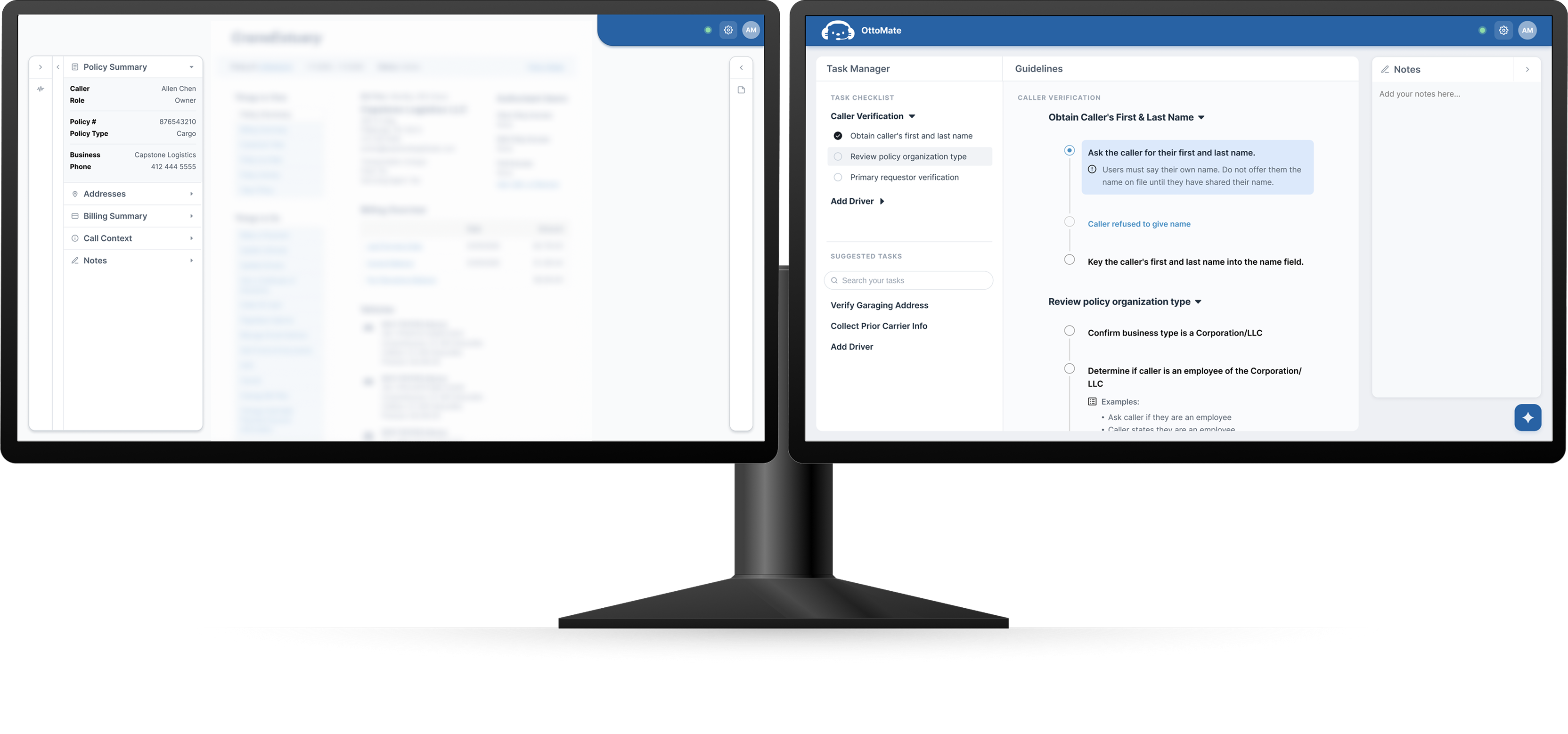
OttoMate is an integrated, AI-powered workspace that centralizes fragmented tools and workflows, surfaces information faster, and reduces decision-making burden.
OttoMate uses a dual-monitor layout to match the typical specialist setup. On one screen, a central workspace handles information surfacing and navigation. On the other, a browser extension layers AI-powered tool panels directly over the input system.